
Overhead High-Speed Press Robot
No ground space occupation · Dual-speed linkage · Single servo high-efficiency cycle time
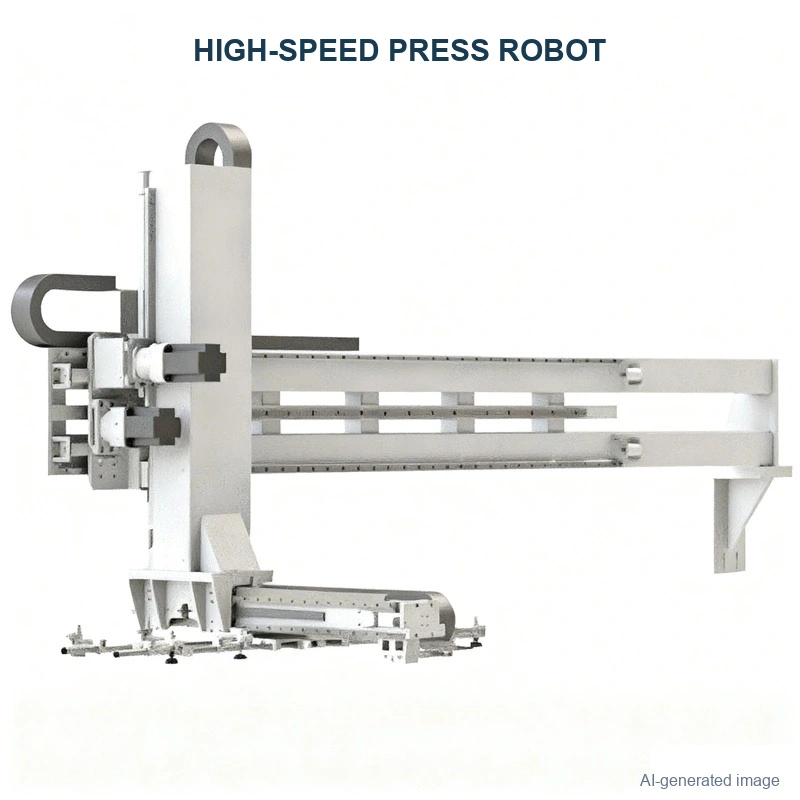
Overhead High-Speed Press Robot
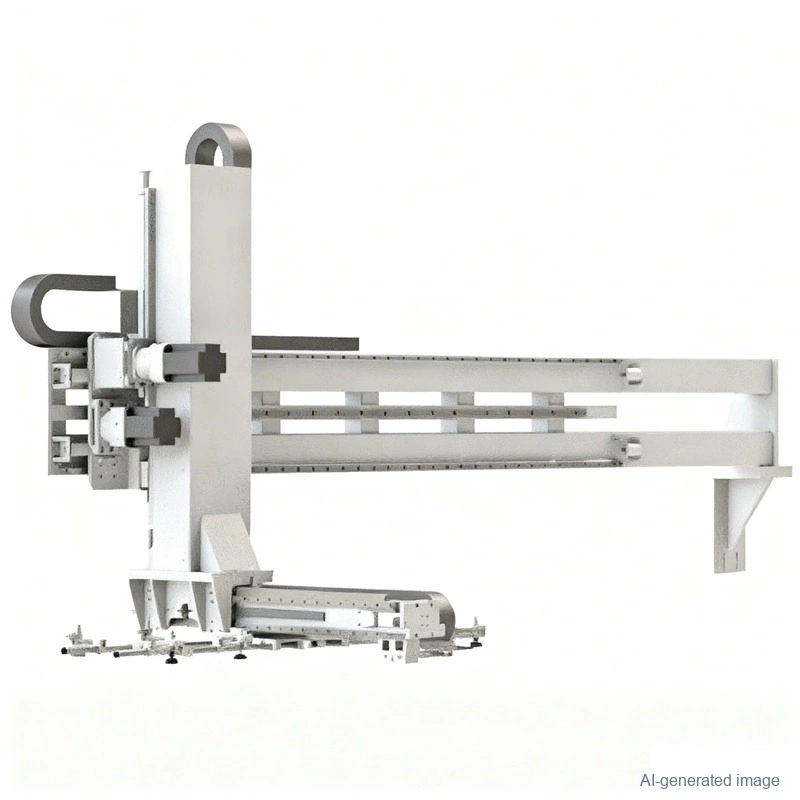
Hanging-type, high-speed translational stamping loading and unloading automation equipment; the core adopts 'single servo + synchronous belt/gear dual-stage linkage,' with the mother arm and child arm stacked in the same direction. The end-effector speed is the sum of the two stage speeds, shortening time consumption and improving cycle rate under the same stroke compared to traditional single-stage arm solutions, significantly enhancing operational efficiency. The entire machine is fixed above the press or on a beam, occupying no floor space, making it suitable for compact production layouts with multiple presses in series.
Product Details
speed ratio mechanism:In a traditional single-segment arm, the full stroke corresponds to one travel time, with the speed limit constrained by the mechanism. The high-speed solution uses nested two-segment modules and single-drive synchronous actuation; when the main arm moves, the sub-arm slides in the same direction, making the end-effector's combined speed the sum of the main and sub-arm speeds. This significantly reduces cycle time for the same transfer distance. Data example: When the extension is approximately 1.7 m, a single pick-and-place can be as low as approximately 2.3 seconds (subject to actual project commissioning).
Structural Composition:The lifting frame bears the entire machine load and aligns with the production line; the drive unit centers on a single servo, balancing energy consumption and cost; the two-stage telescopic arm mostly uses high-strength aluminum alloy, balancing lightweight design and rigidity; the control system collaborates between PLC and servo drives, supporting multi-axis linkage and cycle time optimization. It can replace manual labor for highly repetitive and high-risk tasks such as loading and unloading, while servo closed-loop control helps reduce impact and positioning errors.
Applications and upgrades:Suitable for multi-station connection of 3 to 8 presses or hydraulic presses, covering processes such as 'blank feeding—drawing—forming—cutting off'; also suitable for high-speed continuous stamping of thin plates and small parts (such as battery shells, terminals, etc.); old production lines can directly replace manual labor, reducing manpower investment per shift; the specific payback period depends on production volume and labor costs.
Solution Description:Transfer stroke, rhythm, and gripper form are customized according to product shape, weight, and press center distance; front-end can be connected to coil unwinding, leveling, feeding machine, or other loading forms; supports safety interlock and extended diagnostic interfaces, special specifications can be customized.
Technical parameters and comparison highlights
| Drive and Transmission | Single servo motor; precision synchronous belt / gear two-stage linkage (mother arm + son arm same-direction superposition) |
|---|---|
| Operating cycle (reference) | Efficient cycle time is approximately 2~4 seconds/cycle; conventional single-stage solutions are typically 5~8 seconds/cycle (related to mold, stroke, and travel, with process evaluation as a reference). |
| Extended Arm Stroke (Reference) | Commonly adjustable about 1.5~2.5 m, can be extended or shortened according to project needs |
| Repeatability positioning accuracy | Approx. ±0.02 mm (servo closed-loop, load and speed related) |
| End execution | Vacuum suction cups / pneumatic grippers, modular interchangeability, suitable for various products |
| control system | PLC + servo drive, adjustable HMI parameters, supports cycle optimization |
| Installation Layout | Mounted above the press or horizontal beam, it does not occupy floor space or large lateral areas of workstations. |
| Energy Consumption and Maintenance | Single-servo routing helps control energy consumption; the structure is relatively simplified with concentrated maintenance points. Specific comparisons depend on the model. |
| Typical Industries | Automated production lines for automotive, home appliance, 3C, and new energy sheet metal and small press parts |
| Special specifications | Customizable stroke, cycle time, gripper, and line interface |
Comparison with Traditional Single-Axis Robot (Summary)
| comparison item | Traditional single-axis press robot | Overhead High-Speed Press Robot |
|---|---|---|
| drive method | Multi-servo or Pneumatic Combination | Single servo + synchronous belt dual-section linkage structure |
| Motion Speed | Cycle Time: Approximately 5~8 seconds | Doubled speed range approximately 2~4 seconds / cycle |
| Installation Method | Floor-standing or side-hung, occupying floor or side space | Hanging Installation, No Floor Space Occupied |
| Energy Consumption Level | Relatively high | Material consumption can be reduced by approximately 30% or more compared to traditional solutions (depending on configuration and operating conditions). |
| Maintenance and Return on Investment | Maintenance cost and cycle vary by model | Simplified structure, easy maintenance; documentation recovery cycle can be shortened to about 3-4 months (based on production volume and manpower) |
Related products
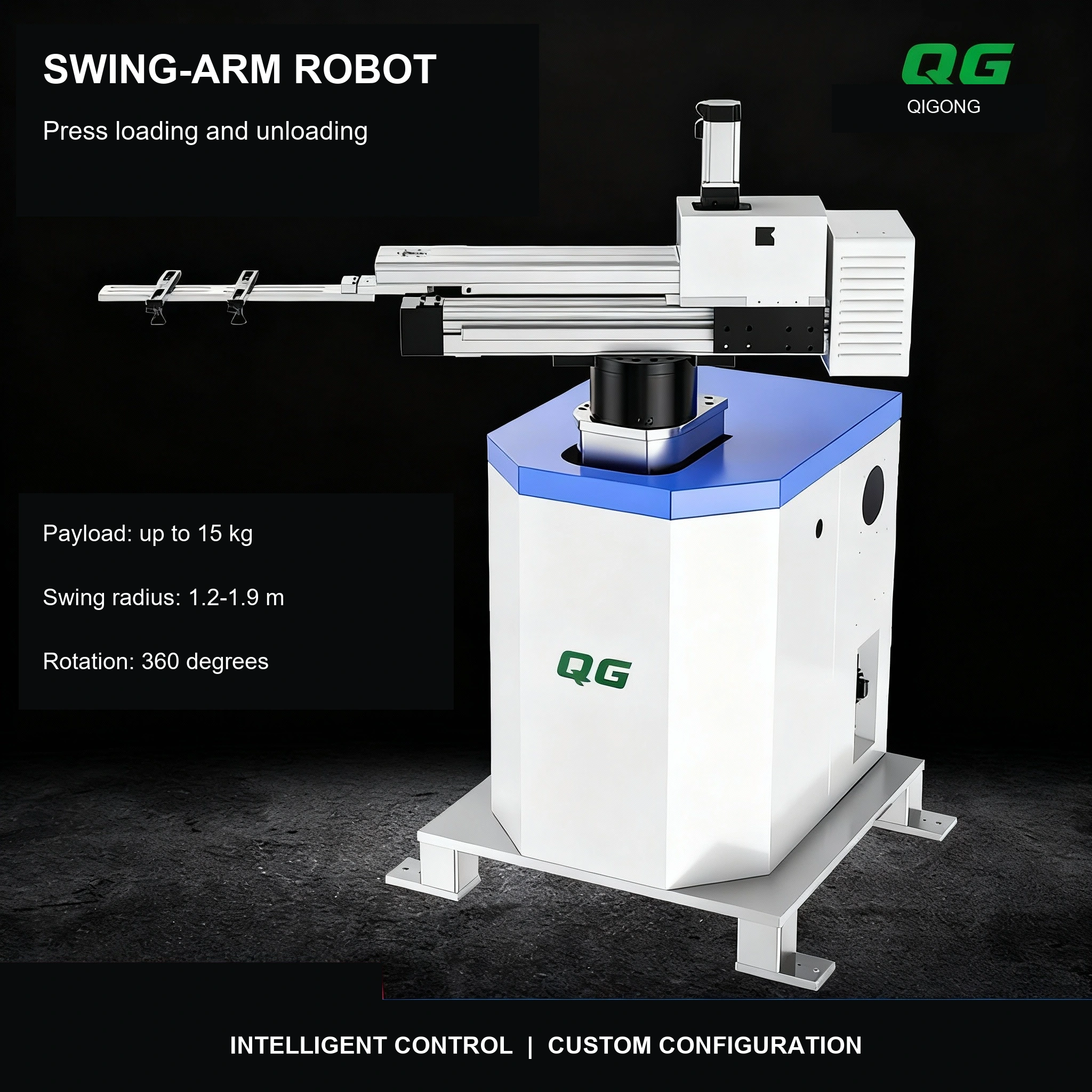
4-Axis Swing-Arm Press Robot
Four-Axis Servo Arm Avoidance, Multi-Station Transfer Cycle Stable
Learn More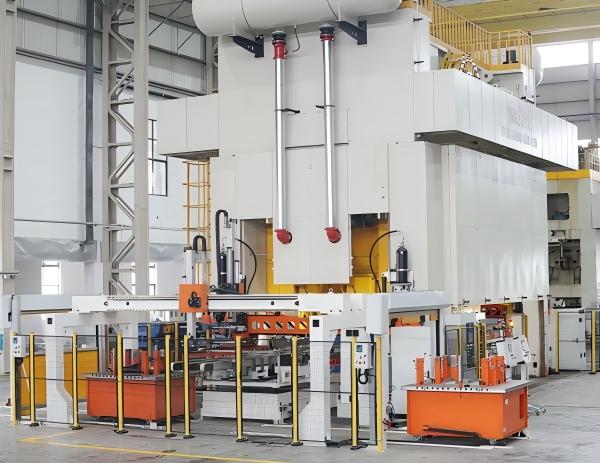
3-Axis Multi-Station Press Robot
Three-axis linkage, high-speed and high-precision, for stamping complex parts in multiple processes.
Learn More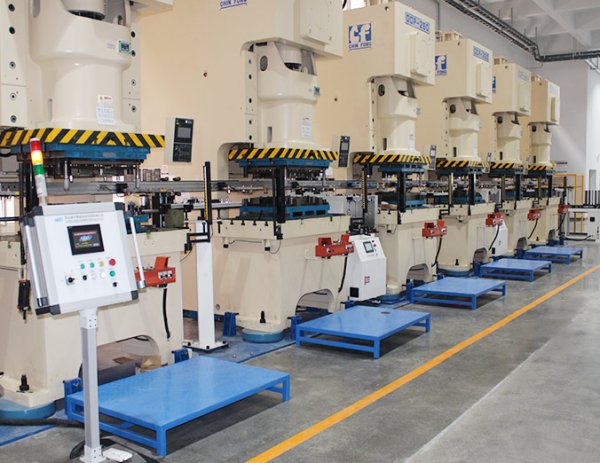
Single-Bar Multi-Press Transfer Robot
Synchronized multi-machine connection, enhancing overall line output and automation level
Learn MoreScan to Connect · Request a Solution
Scan to add us on WeChat or follow us on Douyin for a free technical consultation and preliminary proposal.

Official WeChat
Direct Communication · Fast Service

Official Douyin
Case Demos · Technical Insights